
Fuses, relays and circuit breakers - general information
Pre-1986 models 1 The fuses and most of the relays are located in a plastic box attached to the bulkhead on the driver’s side of the engine compartment.
2 The fuses are numbered to identify the circuit which they protect and the circuits are represented by symbols on the plastic fusebox cover (see illustrations).
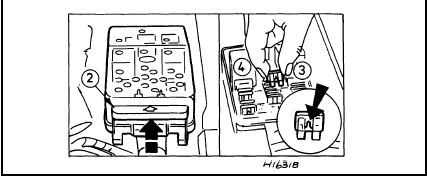
3.2a Fuse and relay box showing plastic cover removal (2), fuse removal (3)
and relays (4). Check if fuse has blown at point indicated in inset
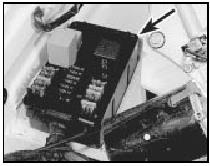
3.2b Fusebox location (arrowed) on engine compartment bulkhead - cover
removed to show fuses and relays
3 When an accessory or other electrical component or system fails, always check the fuse first. The fuses are coloured red (10A), blue (15A), yellow (20A), clear (25A) and green (30A). Always renew a fuse with one of an identical rating. Never renew a fuse more than once without finding the source of the trouble.
Spare fuses are carried in the fusebox lid.
4 The radio, and where fitted, electrically operated aerial, have their own in-line circuit fuses, or are fused in the rear of the radio casing.
5 Relays are of the plug-in type and will be found within the fusebox with a symbol on the cover designating the relay circuit. Additional relays for the headlamp washers, fuel injection system and speed sensor (where fitted) are located below the facia on the driver’s side, and a relay for the central locking system is located under the instrument panel next to the glove compartment.
6 Circuit breakers are only fitted to vehicles equipped with electrically operated windows or a central locking system. The circuit breakers are also located in the fusebox.
1986 models onwards
7 The fusebox and its location are the same
on later models but the fuse positions and
circuits protected have been rearranged.
Additional fuses are still used and located as for early models. A central locking system relay is no longer fitted following circuit modifications.
8 Relays located in the fusebox have their circuits designated by a symbol for identification. Up to six additional relays are located under the instrument panel on the driver’s side. These are used in conjunction with the speed sensor, diode assembly, fuelinjection system, heated windscreen, and dim-dip lighting system. On certain RS Turbo models, a relay to prevent radio interference by the ignition system is fitted adjacent to the fuel-injection module behind the plenum chamber in the engine compartment.
9 The direction indicator/hazard flasher relay is located at the rear of the direction indicator multi-function switch on the steering column.
See also:
Throttle cable - adjustment, removal and refitting
Adjustment
1 Disconnect the battery earth lead.
2 On manual transmission models remove
the air cleaner unit, as given in Section 2.
3 Get an assistant to sit in the driving seat
and fully depress ...
Carburettor (Weber 2V TLD) - removal and refitting
Caution: Refer to the
precautions in Section 1 before
proceeding.
Note: A new gasket must be used when
refitting the carburettor. A tachometer and an
exhaust gas analyser will be required to chec ...
Air Charge Temperature (ACT) sensor - removal and refitting
Removal
1 The air charge temperature sensor is
screwed into the inlet manifold (see
illustration).
14.1 Air charge temperature sensor - 1.6 EFI engine
A Wiring plug B Sensor
2 Disconnect the b ...
