
Loudspeakers - removal and refitting
Facia mounted loudspeaker
Removal
1 Carefully prise up the speaker grille using a
small screwdriver. Lift it from the facia.
2 Extract the speaker mounting screws which are now exposed.
3 Lift the speaker up until the connecting wires can be disconnected by pulling on their terminals. The wires have different connecting terminals to prevent incorrect connection.
Refitting
4 Refitting is a reversal of removal.
Cowl panel-mounted loudspeaker
Pre-1986 models (except Cabriolet)
Removal
5 Prise out the grille retaining clip.
6 Extract screws as necessary to be able to remove the cowl panel/grille.
7 Extract the four speaker mounting screws and withdraw the speaker until the leads can be disconnected at the rear of the speaker (see illustration).
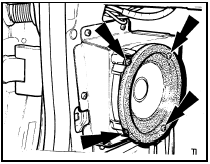
22.7 Cowl mounted loudspeaker retaining screw locations - pre-1986 models
Refitting 8 Refitting is a reversal of removal.
1986 models onwards (except
Cabriolet)
Removal
9 Extract sufficient screws from the scuff
plate to facilitate cowl panel removal.
10 Insert a screwdriver into the captive plastic retainers and turn 90° anti-clockwise to remove them. Withdraw the cowl panel (see illustration).
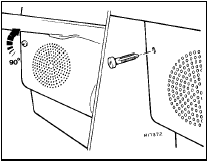
22.10 Cowl mounted loudspeaker panel retainer removal - 1986 models onwards
11 Undo the three speaker retaining screws, disconnect the leads and remove the speaker (see illustration).
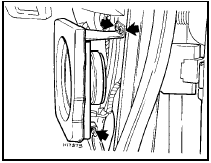
22.11 Cowl mounted loudspeaker retaining screw locations - 1986 models
onwards
Refitting 12 Refitting is a reversal of removal.
Cabriolet models
Removal
13 Extract the screws from the scuff plate.
14 Extract the end screw from the facia panel.
15 Prise the door weatherseal from the cowl panel.
16 Remove the cowl panel and, if required, unclip the speaker grille.
17 Extract the four speaker mounting screws and withdraw the speaker until the leads can be disconnected.
Refitting
18 Refitting is a reversal of removal.
Rear parcel shelf-mounted
loudspeaker
Removal
19 On pre-1986 models, prise the loudspeaker
cover free by inserting a screwdriver blade into
the slots on the side of the cover (see
illustration).
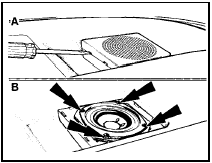
22.19 Rear parcel shelf-mounted loudspeaker removal - pre-1986 models
A Prising cover open B Retaining screw locations
20 On all models undo the four speaker retaining screws, pull the speaker away from the shelf and disconnect the wires.
Refitting
21 Refitting is a reversal of removal.
Rear parcel tray-mounted
loudspeaker
Removal
22 Unscrew the collar and pull the wiring
plug from the loudspeaker.
23 Remove the rear parcel tray. Unscrew the four retaining screws and remove the speaker.
Refitting
24 Refit in the reverse order to removal.
Rear quarter panel-mounted
loudspeaker - Cabriolet models
Removal
25 Fully open the roof and lock it.
26 Pull off the roof release lever knob and remove the window winder.
27 Pull back the rear quarter trim panel then remove the three screws and withdraw the trim panel with the speaker.
28 Disconnect the wiring then extract the screws and detach the speaker and grille from the panel. Note the location of the washers.
Refitting
29 Refitting is a reverse of removal. Position the
speaker so that the terminals face forwards.
See also:
Manifolds, exhaust and emission control systems
All models utilise a light alloy inlet manifold which on
carburettor models is coolant heated to improve the atomisation of the fuel/air
mixture.
The exhaust manifold is of cast iron construction ...
Oil filler cap cleaning - OHVand HCS engines (Every 6000 miles
or 6 months)
1 Simply pull the oil filler cap from the rocker
cover and, where applicable, disconnect the
hose(s) from the cap.
2 Inspect the filler cap, and if necessary clean
the cap using clean petrol to re ...
EEC IV system components - removal and refitting
Note: Procedures for removal and refitting of
the ignition system components and
electronic module are given elsewhere in the
relevant Sections of this Chapter.
Engine coolant temperature
sensor
...
