
Heater unit - overhaul
1 With the heater unit removed from the vehicle, remove the two securing screws and withdraw the heater matrix from the casing (see illustrations).
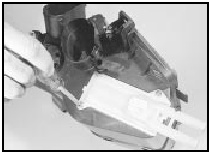
19.1a Remove the securing screws . . .
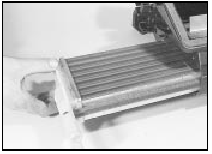
19.1b . . . and withdraw the heater matrix
2 Cut the heater casing gasket in line with the casing joint, then use two suitable screwdrivers to prise off the retaining clips and separate the casing halves. Withdraw the lower part of the casing to the side.
3 Remove the air flap valves, then press the control levers from the casing. Note that the “up/down” control lever can only be removed when the marks are aligned as shown (see illustration).
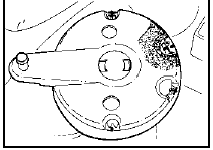
19.3 Heater “up/down” control lever must be aligned as shown before removal
Note that the cross marks are for right-hand drive vehicles
4 Clean all components and hose through the matrix to remove any debris. If necessary use a chemical cleaner to clear the inner passage of the matrix. Renew the components as necessary.
5 Reassembly is a reversal of dismantling.
See also:
Rear brake shoes - renewal
Warning: Brake shoes must be
renewed on both rear wheels at
the same time - never renew the
shoes on only one wheel, as
uneven braking may result. Also, the dust
created by wear of the shoes may ...
Method of engine removal
Warning: Vehicles equipped
with air conditioning:
Components of the air
conditioning system may
obstruct work being undertaken on the
engine, and it is not always possible to
unbolt and move the ...
Windscreen, rear window and fixed rear quarter windows - removal and
refitting
Removal
1 With the exception of the cab rear window
on P100 models, all fixed glass panels are
direct glazed to the body using a special
adhesive. Special tools are required to
remove the old gla ...
