
Steering wheel - removal and refitting
Removal
1 According to model, either pull off the
steering wheel trim, prise out the insert which
carries the Ford motif at the centre, or carefully
prise up and lift off the horn push followed by
the contact plate (see illustrations).
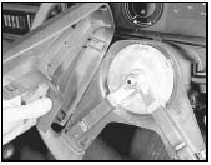
22.1a Steering wheel trim removal
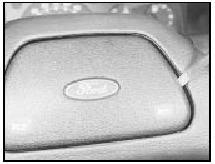
22.1b Prising up the steering wheel horn push . . .
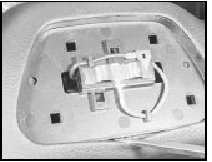
22.1c . . . followed by the contact plate
2 Insert the ignition key and turn it to position I.
3 Hold the steering wheel from turning and have the front roadwheels in the straightahead attitude. Unscrew the steering wheel retaining nut using a socket and extension.
4 Withdraw the steering wheel from the shaft.
No great effort should be necessary, as the wheel is located on a hexagonal-section shaft, which does not normally cause the binding associated with splined shafts. However, if difficulty is experienced, a puller may be used to withdraw the wheel - take adequate precautions to avoid damage to the finish.
5 Where applicable note the steering shaft direction indicator cam which has its peg uppermost.
Refitting
6 Refitting is the reverse sequence to
removal. Ensure that the direction indicator
switch is in the neutral position (this will avoid
the possibility of damage to the selfcancelling
mechanism). Check that the
roadwheels are still in the straight-ahead
position and locate the steering wheel with
the larger section between the spokes
uppermost. Tighten the steering wheel
retaining nut to the specified torque.
See also:
Air cleaner - removal and refitting
K-Jetronic system
Removal
1 Remove the air cleaner element as
described in Chapter 1.
2 Detach the fuel filter from the side of the
cleaner casing (leave the fuel lines attached to
the filter) a ...
Turbocharger - general description
Escort RS Turbo models are equipped with
an exhaust driven turbocharger, which is a
device designed to increase the engine’s
power output without increasing exhaust
emissions or adversely affectin ...
Front and rear brake pad/shoe check (Every 6000 miles (10 000 km) or 6
months)
1 Firmly apply the handbrake, then jack up
the front and rear of the car and support it
securely on axle stands (see “Jacking and
vehicle support”).
2 For a quick check, the front brake disc pads
...
