
Ignition system component check (Every 24 000 miles (40 000 km) or 2 years)
1 Before disturbing any part of the ignition system, disconnect the battery negative lead.
2 Identify and clearly mark all HT leads before disconnecting them from the spark plugs.
3 Refer to the appropriate Section in Chapter 5 and, where applicable, remove the distributor cap and rotor arm.
4 Clean the HT leads and distributor cap with a dry cloth. Scrape any corrosion or other deposits from the connectors and terminals.
Also clean the coil tower.
5 Renew the HT leads if they are cracked, burnt or otherwise damaged. If a multi-meter is available, measure the resistance of the leads. The desired value is given in the Specifications of Chapter 5.
6 Renew the distributor cap if it is cracked or badly burnt inside, or if there is evidence of “tracking” (black lines marking the path of HT leakage). If there is a carbon brush at the centre of the cap, make sure that it moves freely, and is not excessively worn (see illustration).
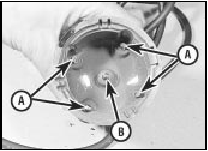
39.6 Bosch distributor cap showing HT segments (A) and carbon brush (B)
7 Clean the metal track of the rotor arm with fine abrasive paper. Renew the arm if it is cracked or badly burnt.
8 Refit the rotor arm and distributor cap.
9 Reconnect the HT leads to the spark plugs and coil.
10 Reconnect the battery and run the engine.
See also:
Rear suspension lower arm (Saloon and Estate models) - removal
and refitting
Removal
1 Raise the rear of the car and support it on
stands (see “Jacking and Vehicle Support”).
2 On cars equipped with the anti-lock braking
system, refer to Chapter 9 and remove the
load appo ...
Fuel vapour separator (models from 1985) - removal and refitting
Caution: Refer to the
precautions in Section 1 before
proceeding.
Removal
1 On SOHC models, the vapour separator is
located on the left-hand side of the engine
compartment. On CVH models, the va ...
Coolant pump - removal and refitting
1 Disconnect the battery negative lead.
2 Drain the cooling system.
3 Proceed as follows according to model:
SOHC models
4 Disconnect the heater and radiator bottom
hoses from the coolant pump.
...
