
Fuel system (1.6 and 1.8 litre (R6A type) CVH) - depressurisation
Remember to depressurise the fuel system before loosening any connections.
Refer to the precautions in Section 1 before proceeding. The fuel system will remain pressurised after the engine is switched off.
1 Disconnect the battery negative lead.
2 Remove the air cleaner assembly.
3 Position a suitable container (or a sufficient quantity of absorbent cloth) beneath the fuel inlet connection on the CFI unit.
4 Use an open-ended spanner on the flats of the inlet union screwed into the CFI unit, to prevent it from turning while the inlet pipe union is loosened (see illustration). Allow all pressure/fuel seepage to dissipate before fully unscrewing the union if it is to be disconnected, or tightened if another part of the system is to be worked on.
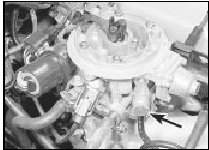
4.4 CFI unit fuel inlet union (arrowed)
5 The system will remain depressurised until the fuel pump is primed prior to starting the engine. Remove the container or cloth, as applicable, on completion.
Fuel filter - renewal
Refer to Chapter 1, Section 41.
See also:
Compression test
1 When engine performance is poor, or if
misfiring occurs which cannot be attributed to
the ignition or fuel system, a compression test
can provide diagnostic clues. If the test is
performed regul ...
Turbocharger - general description
Escort RS Turbo models are equipped with
an exhaust driven turbocharger, which is a
device designed to increase the engine’s
power output without increasing exhaust
emissions or adversely affectin ...
Auxiliary warning system components - location, testing, removal and
refitting
Location
1 The AWS control unit, and (when fitted) the
bulb failure monitor, are located behind the
glovebox on models up to 1987.
2 On models from 1987, the control and bulb
failure modules are ...
