
Fuel filter renewal - fuel injection engines (Every 24 000 miles or 2 Years)
Warning: This procedure may result in some fuel spillage. Before carrying out any operation on the fuel system refer to the precautions given in Safety First! at the beginning of this manual and follow them implicitly. Petrol is a highly dangerous and volatile liquid and the precautions necessary when handling it cannot be overstressed.
Bosch K-Jetronic and KE-Jetronic
fuel injection models
1 Disconnect the battery negative lead.
2 Relieve the system pressure (Chapter 4, Part B).
3 Place absorbent rags beneath the filter and disconnect the fuel inlet and outlet connections (see illustration).
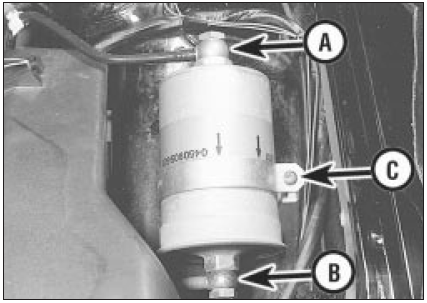
36.3 Fuel filter inlet pipe (A), outlet pipe (B) and clamp screw (C)
4 Slacken the clamp bracket screw and withdraw the filter from the bracket.
5 Refitting is the reversal of removal, but ensure that the arrows on the filter body point in the direction of fuel flow; ie towards the outlet pipe union. On completion check for fuel leaks with the engine running.
Central Fuel Injection (CFI)
models
6 Disconnect the battery negative lead.
7 Position a suitable container beneath the fuel filter to catch any escaping fuel, then slowly slacken the fuel inlet pipe union, allowing the pressure in the fuel line to dissipate. When fully dissipated, disconnect the fuel inlet and outlet pipe unions. Take adequate fire precautions.
8 Note the orientation of the flow direction markings on the filter casing, then remove the clamp bolt and withdraw the filter from the vehicle. Note that the filter will still contain fuel, and care should be taken to avoid spillage.
9 Refitting is a reversal of the removal procedure, but ensure that the flow direction markings on the filter casing are correctly orientated, and tighten the unions to the specified torque.
10 On completion, switch the ignition on and off at least five times, and check for fuel leakage.
Electronic Fuel Injection (EFI)
models
11 The filter is located in the engine
compartment.
12 Depressurise the fuel system as described in Chapter 4, Part D, then disconnect the inlet and outlet unions from the filter.
13 Note the orientation of the flow direction markings on the filter casing, then remove the clamp bolt and withdraw the filter from the vehicle. Note that the filter will still contain fuel, and care should be taken to avoid spillage.
14 Refitting is a reversal of the removal procedure, but ensure that the flow direction markings on the filter casing are correctly orientated, and tighten the unions to the specified torque.
15 On completion, switch the ignition on and off at least five times, and check for fuel leakage.
See also:
Cold start valve - removal and refitting
Note: Refer to the precautions at the end of
Section 1 before proceeding.
K-Jetronic system
Removal
1 Disconnect the battery earth lead.
2 Detach the electrical wiring multi-plug from
the valve ...
Throttle cable - adjustment, removal and refitting
The procedure is similar to that described in
Part A of this Chapter for carburettor engines. ...
Rear suspension front mounting (Saloon, Hatchback and Estate models) -
renewal
1 Chock the front wheels, jack up the rear of
the vehicle and support on axle stands placed
under the side members.
2 Unscrew and remove the three bolts
securing the relevant front guide plate to ...
