
Turbocharger- removal and refitting
Note: New gaskets and new tabwashers must be used on refitting.
Removal
1 Disconnect the battery negative lead.
2 Disconnect the turbocharger inlet and outlet air hoses and the hoses from the waste gate actuator and solenoid control valve at their turbocharger connections. Tape over all the disconnected unions and outlets to prevent dirt ingress.
3 Support the exhaust system and disconnect it from the turbocharger exhaust manifold .
4 Disconnect the oil feed union on the top of the turbocharger and the oil return line from underneath the unit (see illustration). Tape over all disconnected pipes and unions.
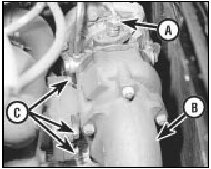
23.4 Turbocharger oil feed union (A), turbocharger exhaust manifold (B) and
retaining nuts (C)
5 Bend up the tabwashers, then unscrew the nuts securing the turbocharger to the exhaust manifold. Remove the unit and store it in a clean plastic bag while removed from the car.
Refitting
6 Before refitting the turbocharger ensure
that all mating faces are clean and obtain new
gaskets and a set of new tabwashers. It is
also advisable to renew the engine oil and
filter, particularly if a new turbocharger is
being fitted or if there was any sign of
previous oil contamination.
7 Refitting is a reversal of removal, but bearing in mind the following points: a) Tighten all retaining nuts to the specified torque and secure with the tabwashers.
b) Before connecting the oil feed union, prime the turbocharger bearings by injecting clean engine oil into the union orifice.
c) Crank the engine over on the starter with the ignition LT lead at the coil disconnected until the oil pressure warning light goes out.
See also:
Engine/transmission - removal and separation
Note: Suitable lifting tackle will be required for
this operation.
Carburettor engines
Removal
1 The engine is removed complete with the
transmission in a downward direction and then
withdrawn f ...
Oil pump - removal and refitting
Note: A suitable puller will be required to
remove the crankshaft pulley. A new
crankshaft pulley bolt, a new lower timing
chain cover gasket, and a new oil pump
gasket, must be used on refitting. ...
Fuses, relays and circuit breakers - general information
Pre-1986 models
1 The fuses and most of the relays are
located in a plastic box attached to the
bulkhead on the driver’s side of the engine
compartment.
2 The fuses are numbered to identify the
...
