
Throttle cable - removal, refitting and adjustment
Removal
1 Disconnect the battery negative lead.
2 Working inside the vehicle, remove the lower facia panel from the driver’s side.
3 Prise off the securing clip and disconnect the end of the throttle cable from the top of the pedal.
4 Working in the engine compartment, free the cable sheath from the bulkhead, and pull the cable through into the engine compartment. It will probably be necessary to pull the cable grommet from the bulkhead in order to free the cable sheath.
5 For improved access, remove the air cleaner.
6 Disconnect the cable end from the throttle linkage. The cable end may be attached to the linkage with a balljoint and spring clip, a spring clip only, or the cable end may simply locate in a slot in the throttle lever (see illustration).
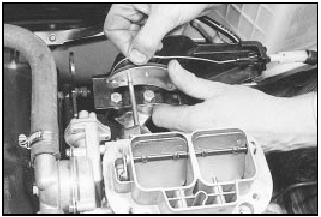
12.6 Disconnecting the throttle cable end from the throttle lever - Weber 2V
carburettor
7 Prise off the spring clip securing the cable sheath to the cable bracket at the carburettor inlet manifold. Depress the four lugs on the plastic cable retainer simultaneously so that the retainer can be slid from the bracket, or remove the retainer securing clip, as applicable (see illustration). Take care not to damage the cable sheath.
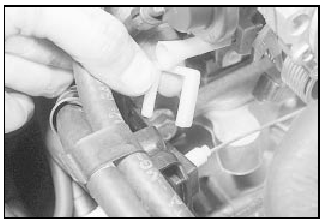
12.7 Removing the throttle cable sheath retainer securing clip - CVH model
Refitting
8 Refitting is a reversal of removal, but before
refitting the air cleaner, adjust the cable as
follows.
Adjustment
9 Have an assistant fully depress the throttle
pedal and hold it in this position. On models
with automatic transmission, where
applicable ensure that the kickdown cable
does not restrict the pedal movement. Turn
the adjusting sleeve at the carburettor inlet
manifold cable bracket until the throttle is just
fully open. Have the assistant release and
then fully depress the throttle pedal, and
check that the throttle is again fully open.
Adjust if necessary, then refit the air cleaner.
On models with automatic transmission, where applicable check the operation of the kickdown cable, and adjust if necessary.
See also:
Bumper components - removal and refitting
Bumper overriders
Removal
1 On pre-1986 models the overrider is held to
the bumper by a clamp screw. Find this screw
on the underside of the bumper and release it
- the overrider can then be with ...
Anti-lock Braking System - description
1 From 1986 onward an anti-lock braking
system is available as standard or optional
equipment on certain Escort models.
2 The system comprises four main
components: two modulators, one for each
b ...
Rear wheel bearings - renewal
Saloon, Hatchback and Estate
models
With rear drum brakes
Note: There are two types of bolts used to
secure the rear hub carrier to the lower arm
(see illustration).
14.1a Alternative types of ...
