
Oil pump - removal and refitting
Note: A suitable puller will be required to remove the crankshaft pulley. A new crankshaft pulley bolt, a new lower timing chain cover gasket, and a new oil pump gasket, must be used on refitting.
Removal
1 If the engine is in the car, carry out the
following operations:
a) Disconnect the battery negative lead.
b) To improve access, remove the radiator. It will be difficult to remove the crankshaft pulley with the radiator in place.
c) On fuel injection models, remove the air inlet hose, plenum chamber, and air cleaner lid as an assembly.
2 Proceed as described in paragraphs 3 to 10 of Section 15.
3 Unscrew the four securing bolts, and withdraw the oil pump from the cylinder block (see illustrations). Recover the gasket.
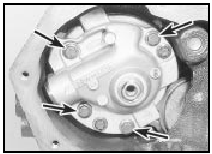
26.3a Oil pump securing bolts (arrowed)
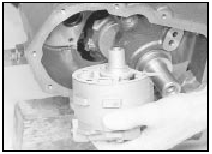
26.3b Withdrawing the oil pump
Refitting
4 Thoroughly clean the mating faces of the
pump and the cylinder block.
5 Prime the pump by injecting clean engine oil into it and turning it by hand.
6 Place a new gasket on the oil pump flange, ensuring that the gasket is correctly located so that its holes align with the oil passages in the pump.
7 Fit the oil pump, and tighten the securing bolts to the specified torque.
8 Proceed as shown in paragraphs 27 to 39 of Section 15.
9 If the engine is in the vehicle, reverse the operations described in paragraph 1.
See also:
Exhaust system - inspection, removal and refitting
Inspection
1 The exhaust system should be examined for
leaks, damage, and security at regular
intervals. To do this, apply the handbrake, then
start the engine and allow it to idle. Lie down on
e ...
Routine maintenance and servicing
Ford Sierra maintenance schedule
The maintenance intervals in this manual
are provided with the assumption that you will
be carrying out the work yourself. These are
the minimum maintenance interv ...
Manifold Absolute Pressure (MAP) sensor - removal and refitting
Removal
1 Disconnect the battery negative lead.
2 Disconnect the sensor wiring plug. Do not
pull on the wiring.
3 Disconnect the vacuum hose from the
sensor.
4 Remove the two securing screws and ...
