
Steering wheel - centralising
1 This operation is for correcting small errors in steering wheel centralisation - up to 60º.
For larger errors, remove the steering wheel and make a rough correction by repositioning the wheel on refitting.
2 Drive the vehicle in a straight line on a level surface. Note the angle by which the steering wheel deviates from the desired straight-ahead position.
3 Raise the front of the vehicle by driving it onto ramps, or with a jack and axle stands.
4 Slacken both tie-rod end locknuts. Also slacken the steering rack bellows outer clips.
5 Make alignment marks between each tie-rod end and its rod, so that the amount of rotation applied can be accurately determined see illustration).
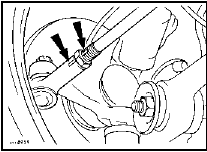
23.5 Make alignment marks (arrowed) between each tie-rod end and its rod when
centralising the steering wheel
6 Turn both tie-rods in the same direction to correct the steering wheel position. As a rough guide, 19º of tie-rod rotation will change the steering wheel position by 1º. To correct a clockwise error at the steering wheel, rotate both tie-rods anti-clockwise (when viewed from the left-hand side of the vehicle), and the reverse to correct an anticlockwise error. Both tie-rods must be rotated by the same amount.
7 Tighten the bellows clips and the tie-rod end locknuts when adjustment is correct.
Lower the vehicle.
See also:
Starter motor - brush renewal
Bosch long frame and JF, and
Cajavec types
1 With the starter motor removed from the
vehicle and cleaned, grip the unit in a vice
fitted with soft jaw protectors.
2 Remove the two screws securing ...
Contact breaker points adjustment - models with contact breaker
distributor (Every 6000 miles or 6 months)
1 Spring back the retaining clips or undo the
screws as appropriate and lift off the
distributor cap.
2 Withdraw the rotor arm from the distributor
shaft.
3 Using a screwdriver, gently prise the
...
Automatic transmission selector mechanism check (Every 12 000
miles or 12 months)
Carry out a thorough road test, ensuring
that all gearchanges occur smoothly without
snatching, and without an increase in engine
speed between changes. Check that all gear
positions can be engage ...
