
Warm-up regulator - removal and refitting
Note: Refer to the precautions at the end of Section 1 before proceeding. New banjo union sealing washers must be used on refitting.
Removal
1 The warm-up regulator is only used on KJetronic
systems and is situated on the inlet
manifold just to the rear of the rocker cover.
2 Disconnect the battery negative lead.
3 Relieve the system pressure by slowly loosening the fuel feed pipe union at the warm-up regulator (see illustration 6.3).
Absorb the fuel leakage in a cloth.
4 After relieving the system pressure disconnect the fuel feed union completely, followed by the outlet union. Recover the sealing washers used on each side of the unions.
5 Disconnect the regulator wiring multi-plug.
6 Undo the two Torx type screws using a suitable Torx key or socket bit and remove the regulator from its location (see illustration).
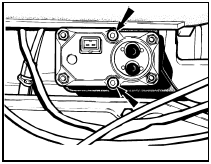
14.6 K-Jetronic system warm-up regulator retaining screws
Refitting 7 Refitting is a reversal of removal, but use new sealing washers on each side of the banjo unions and apply a thread-locking compound to the Torx retaining bolts. On completion check for leaks with the engine running.
See also:
Cab interior trim panels (P100 models) - removal and refitting
Side trim panel
1 Remove the rear pillar trim panel.
2 Remove the side trim panel by prising out
the four expander pins from the clips, then
pulling out the clips and withdrawing the
panel.
3 Re ...
Fuel level sender unit - removal and refitting
Caution: Refer to the
precautions in Section 1 before
proceeding. A new seal must
be used when refitting the
sender unit.
Saloon, Hatchback and Estate
models
All models except 2.0 litre DOHC
1 ...
General information and precautions
General information
The fuel system comprises a centrally
mounted fuel tank, electrically-operated fuel
pump and Bosch K-Jetronic or KE-Jetronic
continuous injection system according to
model. Th ...
