
Exhaust system - renewal
1 The layout of the exhaust system varies considerably according to model and engine.
All except the RS Turbo versions can be renewed in sections; coupling sleeves are supplied, enabling an old section to be cut out and a new one inserted without the need to renew the entire system all at once.
2 It is recommended when working on an exhaust system that the complete assembly be removed from under the vehicle by releasing the downpipe from the manifold and unhooking the flexible suspension hangers (see illustrations).
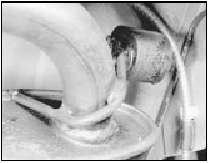
4.2a Exhaust silencer mounting . . .
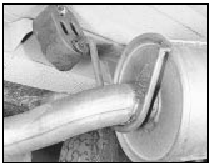
4.2b . . . and expansion box mounting
3 Assemble the complete system, but do not fully tighten the joint clips until the system is back in the vehicle. Use a new exhaust manifold/flange gasket and check that the flexible mountings are in good order, also check the connecting flange joint.
4 Set the silencer and expansion box in their correct attitudes in relation to the rest of the system before finally tightening the joint clips.
5 Check that with reasonable deflection in either direction, the exhaust does not knock against any adjacent components.
See also:
Radiator - removal, inspection and refitting
All models except RS Turbo
Pre-1986 models
Removal
1 Drain the cooling system as described in
Chapter 1.
2 Disconnect the battery negative terminal.
3 Release the retaining clips and disconnect
...
Major body damage - repair
Where serious damage has occurred or
large areas need renewal due to neglect, it
means that completely new sections or panels
will need welding in, and this is best left to
professionals. If the d ...
Engine/transmission - removal and separation
Note: Suitable lifting tackle will be required for
this operation.
Carburettor engines
Removal
1 The engine is removed complete with the
transmission in a downward direction and then
withdrawn f ...
