
Crankshaft rear oil seal - renewal
Note: New flywheel/driveplate bolts must be used on refitting.
1 Remove the flywheel/driveplate and the engine adapter plate.
2 Extract the seal using an oil seal removal tool if available. It may also be possible to remove the oil seal by drilling the outer face and using self-tapping screws and a pair of grips.
3 Clean the oil seal housing, then carefully wind a thin layer of tape around the edge of the crankshaft to protect the oil seal lip as the seal is installed.
4 Ideally, the new oil seal should be installed using a tool similar to that shown (see illustration).
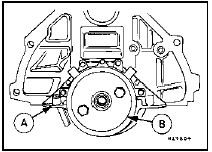
24.4 Tool used to fit crankshaft rear oil seal
A Rear oil seal housing B Special tool
A suitable tool can be improvised using a metal tube of suitable diameter, a metal disc or flat bar, and two flywheel bolts. Draw the seal into position using the two flywheel bolts. Make sure that the seal lip faces into the engine.
5 With the oil seal installed, carefully pull the tape from the edge of the crankshaft.
6 Refit the engine adapter plate and the flywheel/driveplate.
See also:
Rear drum brake shoes - inspection and renewal
Caution: Refer to the
precautions in Section 1
1 The shoe friction material can be inspected
for wear without removing the roadwheels.
Working beneath the vehicle, prise the plug
from the brake b ...
Suspension and steering
General information
The front suspension is of independent
MacPherson strut type incorporating coil
springs and integral telescopic shock
absorbers. The lower end of each strut is
attached to a h ...
Crankshaft and bearings - examination and renovation
1 Examine the bearing surfaces of the
crankshaft for scratches or scoring and, using
a micrometer, check each journal and
crankpin for ovality. Where this is found to be
in excess of 0.0254 mm (0. ...
