
Instrument panel components - removal and refitting
Panel illumination and warning
lamp bulbs
Removal
1 Remove the instrument panel as described
in Section 9.
2 Turn the bulbholders anti-clockwise and remove them from the rear of the instrument panel (see illustration).
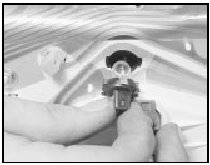
10.2 Instrument panel bulb renewal
3 The bulbs and bulbholders are renewed complete, the bulbs cannot be removed from the holders separately.
Refitting
4 Refit by pushing down and turning
clockwise.
Printed circuit
Removal
5 Remove the instrument panel (Section 9).
6 Remove all illumination and warning lamp bulbholders.
7 Undo all the nuts and remove the washers from the printed circuit terminals.
8 Remove the wiring multi-plug retainers and carefully pull the printed circuit off the pins on the rear of the panel.
Refitting
9 Refitting is the reverse sequence to
removal.
Speedometer
Removal
10 Remove the instrument panel as
described in Section 9.
11 Undo the retaining screws around the edge of the panel at the rear and separate the two panel halves (see illustrations).
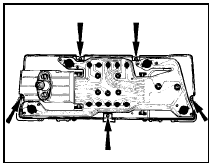
10.11a Instrument panel assembly retaining screws-pre-1986 models
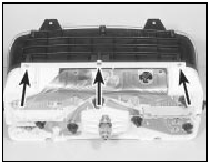
10.11b Instrument panel assembly upper retaining screws - 1986 models onwards
12 Undo the two screws and remove the speedometer (see illustrations).
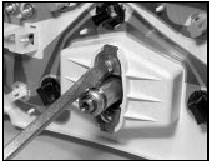
10.12a Extracting speedometer retaining screws
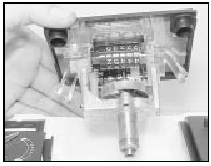
10.12b Removing the speedometer
Refitting 13 Refitting is the reverse sequence to removal.
Tachometer
14 The procedure is the same as for the
speedometer except that the unit is secured
by three nuts.
Fuel and temperature gauges 15 Proceed as for the speedometer but remove the combined gauge assembly after undoing the four nuts.
See also:
Disc pads - inspection and renewal
Caution: Refer to the
precautions in Section 1.
Front disc pads
1 The disc pad friction material can be
inspected for wear without removing the
roadwheels. Working beneath the vehicle,
insert a ...
Exhaust manifold - removal and refitting
Removal
1 Disconnect the battery negative lead.
2 Remove the air cleaner and pull the hot air
pick-up pipe from the exhaust manifold hot air
shroud.
3 Remove the securing screws (1 screw on
DOHC ...
Oil pump - removal and refitting
Note: A suitable puller will be required to
remove the crankshaft pulley. A new
crankshaft pulley bolt, a new lower timing
chain cover gasket, and a new oil pump
gasket, must be used on refitting. ...
