
Cylinder head - removal and refitting (engine in vehicle)
Note: Refer to the warning at the beginning of Section 5 and the note at the beginning of the following Section before proceeding. The cylinder head must not be removed when the engine is warm.
Removal
1 Disconnect the battery negative lead.
2 On carburettor models, remove the air cleaner.
3 On fuel injection models, remove the air inlet hose, plenum chamber, and air cleaner lid as an assembly.
4 Drain the cooling system.
5 Disconnect the heater coolant hose from the inlet manifold (see illustration).
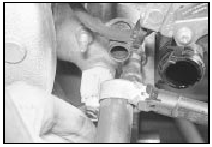
17.5 Disconnecting the heater coolant hose from the inlet manifold
6 Disconnect the breather hose from the camshaft cover, and unbolt the hose bracket from the left-hand side of the cylinder head (see illustration).
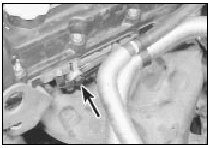
17.6 Hose bracket bolted to cylinder head (arrowed)
7 Unscrew the securing bolt and disconnect the earth lead from the left-hand rear of the cylinder head (see illustration).
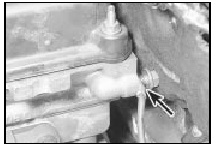
17.7 Disconnect the earth lead (arrowed) from the cylinder head
8 Remove the distributor cap and HT leads, and the rotor arm and housing. If necessary, mark the HT leads to aid refitting.
9 The cylinder head can be removed either with or without the manifolds and fuel rail, where applicable (it is easiest to remove the head complete with the manifolds and fuel rail). If desired, the inlet manifold and the fuel rail can be unbolted and moved to one side, leaving the wires, hoses, pipes and cables connected, but care must be taken not to place any strain on them.
10 Unscrew the three securing nuts and disconnect the exhaust downpipe from the manifold. It may be necessary to jack up the front of the vehicle to gain access to the nuts (in which case, apply the handbrake and support the front of the vehicle securely on axle stands). Recover the gasket.
11 If the inlet manifold and the fuel rail (where applicable) are to be removed with the cylinder head, disconnect all relevant wires, hoses, pipes and cables. Otherwise, unbolt the manifold and the fuel rail, and move them to one side, ensuring that they are adequately supported. If the fuel rail is unbolted, be prepared for fuel spillage, and take adequate fire precautions.
12 Proceed as shown in paragraphs 2 to 19 of Section 18.
Refitting
13 Proceed as shown in paragraphs 20 to 55
of Section 18.
14 With the cylinder head refitted, reverse the procedure described in paragraphs 1 to 11, noting the following points.
15 Use a new gasket when reconnecting the exhaust downpipe to the manifold.
16 Ensure that the HT leads are reconnected correctly.
17 Fill the cooling system.
See also:
Windscreen wiper motor and linkage - removal and refitting
Removal
1 Remove the wiper arms and blades as
described in Section 17.
2 Disconnect the battery negative terminal.
3 Remove the nut covers, the fixing nuts,
washers and spacers from the pivot sha ...
Engine/transmission - reconnection and installation
1 This is a direct reversal of removal and
separation from the transmission. Take care
not to damage the radiator or front wings
during installation.
Reconnection
2 Make sure that the engine adap ...
Electrical fault-finding - general information
Note: Refer to the precautions given in “Safety
first!” and in Section 1 of this Chapter before
starting work. The following tests relate to testing
of the main electrical circuits, and should not ...
