
Engine mountings - renewal
1 The engine mountings incorporate hydraulic dampers and must be renewed if excessive engine movement is evident.
2 Working in the engine compartment, unscrew the central nuts securing the engine mounting brackets to the tops of the mountings. Recover the washers.
3 Apply the handbrake, jack up the front of the vehicle and support on axle stands (see “Jacking and Vehicle Support”).
4 Working underneath the vehicle, remove the central nuts securing the mountings to the crossmember. Recover the washers.
5 Raise the engine using a suitable hoist and lifting tackle attached to the engine lifting brackets on the cylinder head, or a jack and interposed block of wood under the sump, until the mountings can be withdrawn.
6 Fit the new mountings, then lower the engine onto them. Note that the locating pins on the mountings must engage with the corresponding holes in the engine mounting brackets (see illustration).
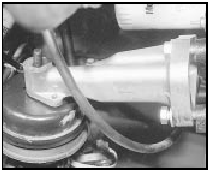
16.6 Locating pin on mounting must engage with hole (arrowed) in engine
mounting bracket
7 Fit the nuts and washers securing the mountings to the crossmember and tighten the nuts.
8 Lower the vehicle to the ground and fit the nuts and washers securing the engine mounting brackets to the mountings. Tighten the nuts.
See also:
Vacuum servo unit and linkage - removal and refitting
Removal
1 Refer to Section 12 and remove the master
cylinder.
2 On fuel-injection models unclip and lift out
the front section of the heater plenum
chamber to provide access to the connecting
li ...
Accelerator pedal - removal and refitting
The procedure is the same as described in
Part A of this Chapter for carburettor models. ...
Front direction indicator side repeater lamp - removal and refitting
1 Disconnect the battery negative lead.
Models up to 1987
2 To improve access, turn the steering onto
full lock.
3 Remove the relevant wheel arch liner.
4 Working under the wheel arch, depress th ...
